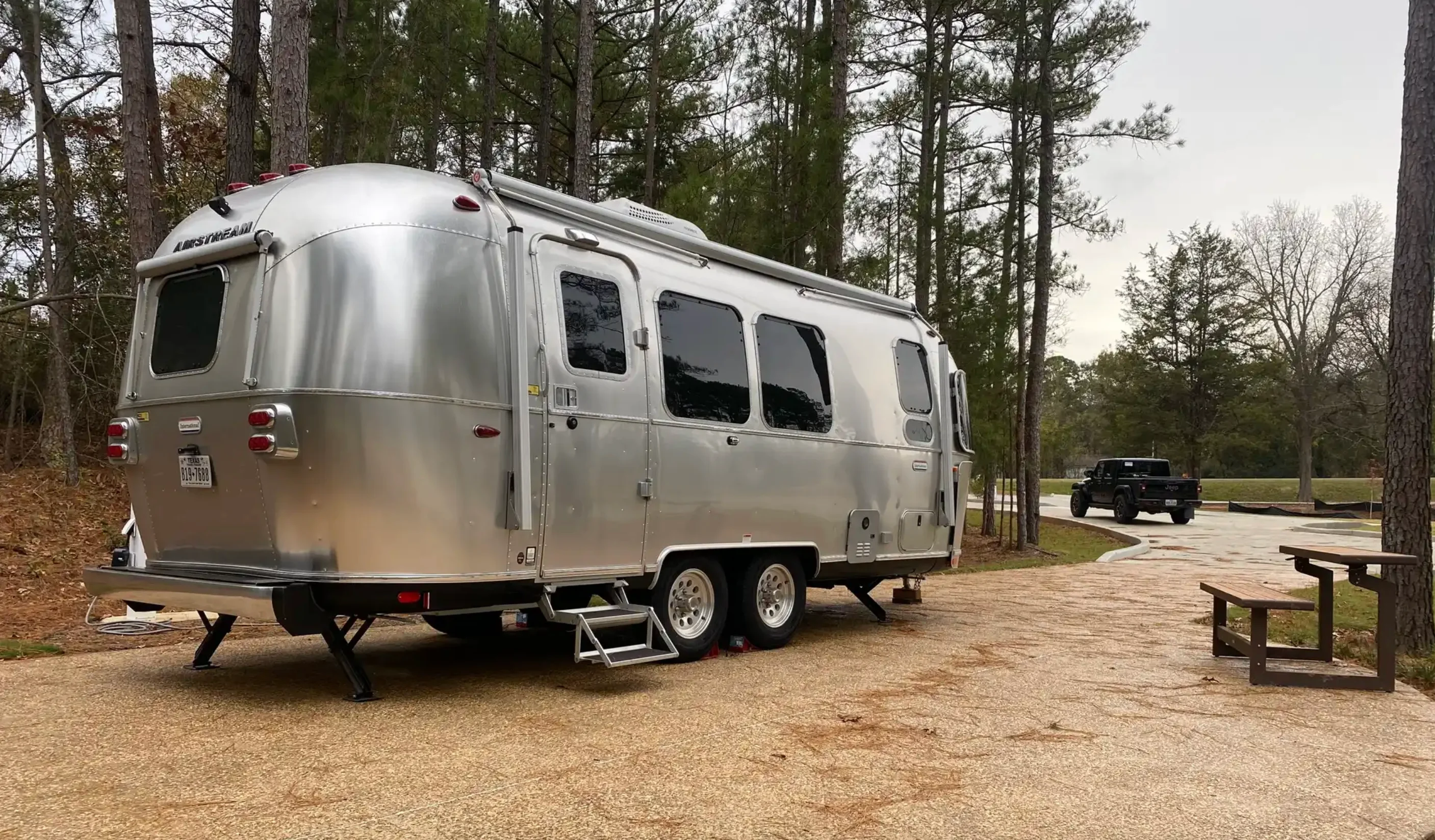
How Much Does a Trailer Weigh? Complete Weight and Towing Guide
Every truck has a towing limit. Every trailer has a weight. Match them wrong and you’ll burn through brakes, overheat transmissions and put yourself in danger on Texas highways.
This guide covers weights for every trailer type, how to look up your tow capacity by VIN, hitch class sizing and how to weigh your rig properly.
Travel Trailer Weight Chart
| Trailer Type | Length | Dry Weight | GVWR | Tongue Weight |
|---|---|---|---|---|
| Teardrop | 8-12 ft | 1,200-2,000 lbs | 1,800-2,500 lbs | 150-250 lbs |
| Pop-Up / Folding | 10-16 ft | 1,500-3,000 lbs | 2,500-4,000 lbs | 200-400 lbs |
| Small Single-Axle | 14-18 ft | 2,500-3,500 lbs | 3,500-4,500 lbs | 300-500 lbs |
| Mid Single-Axle | 18-22 ft | 3,500-4,500 lbs | 4,500-6,000 lbs | 400-600 lbs |
| Standard Dual-Axle | 22-28 ft | 4,500-6,000 lbs | 6,000-7,500 lbs | 500-800 lbs |
| Large Dual-Axle | 28-35 ft | 6,000-8,500 lbs | 7,500-10,000 lbs | 700-1,200 lbs |
| Toy Hauler | 24-36 ft | 5,500-9,000 lbs | 8,000-14,000 lbs | 800-1,500 lbs |
| 5th Wheel | 28-42 ft | 7,000-14,000 lbs | 10,000-18,000 lbs | 1,200-2,500 lbs |
Other Trailer Types — Weight Chart
Not just campers. Here’s what other common trailers weigh:
| Trailer Type | Typical Length | Empty Weight | GVWR |
|---|---|---|---|
| Utility (single axle) | 5-8 ft | 400-800 lbs | 1,200-2,000 lbs |
| Utility (tandem axle) | 10-16 ft | 1,000-2,000 lbs | 3,500-7,000 lbs |
| Car hauler (open) | 16-20 ft | 1,800-2,500 lbs | 7,000-10,000 lbs |
| Enclosed car trailer | 18-24 ft | 2,500-4,000 lbs | 7,000-14,000 lbs |
| Boat trailer (single axle) | 14-20 ft | 300-800 lbs | 1,500-3,500 lbs |
| Boat trailer (tandem) | 20-30 ft | 800-1,500 lbs | 4,000-10,000 lbs |
| Dump trailer | 10-14 ft | 2,800-4,500 lbs | 7,000-14,000 lbs |
| Flatbed gooseneck | 20-40 ft | 4,000-7,000 lbs | 14,000-25,000 lbs |
| Horse trailer (2-horse) | 14-16 ft | 2,500-3,500 lbs | 7,000-7,500 lbs |
| Livestock trailer | 16-24 ft | 3,000-5,000 lbs | 10,000-14,000 lbs |
Car trailers weigh 1,800-4,000 lbs empty. Add the car itself (3,000-5,000 lbs for a sedan, 5,000-7,000 lbs for a truck or SUV) and you need a serious tow vehicle.
Dump trailers are deceptively heavy. The hydraulic lift system alone adds 500-800 lbs over a comparable flatbed. A loaded dump trailer with gravel or dirt easily hits 10,000-14,000 lbs.
How Wide Is a Trailer?
Width matters for lane positioning, passing clearance and storage.
| Trailer Type | Body Width | With Mirrors/Awning |
|---|---|---|
| Teardrop / Small | 60-72 in (5-6 ft) | Same |
| Pop-Up | 72-84 in (6-7 ft) | Same |
| Travel Trailer | 96 in (8 ft) | 96-102 in |
| 5th Wheel | 96-102 in (8-8.5 ft) | 96-102 in |
| Toy Hauler | 96-102 in (8-8.5 ft) | 96-102 in |
| Utility Trailer | 48-84 in (4-7 ft) | Same |
Most full-size travel trailers are 96 inches (8 feet) wide. That’s the maximum width allowed on public roads without an oversized load permit in most states.
Slide-outs add 2-3 feet per side when extended at camp but fold flush for highway travel. A trailer with opposing slides can be 14-16 feet wide at a campsite.
Understanding Trailer Weight Terms
Dry Weight (UVW)
The trailer as it leaves the factory. No water, propane, battery, cargo or options. Dealers advertise dry weight because it looks low.
Nobody tows an empty trailer. Dry weight is the starting point, not the real number.
GVWR (Gross Vehicle Weight Rating)
The maximum loaded weight the trailer is designed to handle. Set by the manufacturer based on axle ratings, frame strength, tire capacity and suspension. This number is stamped on the federal certification label (usually on the trailer tongue or A-frame).
Exceeding GVWR overloads tires, brakes and axle bearings. It also voids your warranty and creates a liability problem if something fails.
Payload Capacity (CCC)
GVWR minus dry weight. This is how much stuff you can load inside.
A trailer with 5,000 lb dry weight and 7,000 lb GVWR has 2,000 lbs of payload. That disappears fast:
- Fresh water (40 gal) = 334 lbs
- Propane (2 tanks) = 80 lbs
- Battery = 60 lbs
- Camping gear = 200-400 lbs
- Food and supplies = 100-200 lbs
- Personal items = 200-400 lbs
That 2,000 lbs becomes 900 lbs pretty quick. Know your real payload before loading up.
Tongue Weight
The downward force the trailer puts on the hitch ball. Should be 10-15% of total loaded trailer weight. A 6,000 lb trailer needs 600-900 lbs of tongue weight.
Too little tongue weight causes trailer sway — dangerous at highway speed. Too much overloads the truck’s rear axle and lifts the front end, reducing steering response.
For a deep breakdown, read our tongue weight guide.
GCWR (Gross Combined Weight Rating)
The maximum weight of the truck, trailer, passengers, cargo and fuel — everything, combined. Your truck’s GCWR is on the door sticker. Subtract the loaded truck weight to find your real towing capacity.
This is the number most people miss. A truck might be rated to tow 10,000 lbs on paper, but after you factor in the truck’s own weight, passengers and bed cargo, your actual available towing capacity drops to 7,000-8,000 lbs.
How to Find Your Tow Capacity by VIN
The maximum tow rating printed in brochures is for one specific configuration — usually the lightest cab with the biggest engine and highest axle ratio. Your truck is probably different.
Method 1: Door Sticker (Fastest)
Open the driver’s door. There’s a federal certification label and usually a separate towing/payload label. The towing label shows your specific truck’s tow capacity based on its actual build — engine, transmission, axle ratio and tow package.
If the sticker is worn or missing, use the VIN.
Method 2: Manufacturer VIN Lookup
Every major truck manufacturer has an online towing guide where you enter your VIN:
| Manufacturer | Towing Guide URL |
|---|---|
| Ford | fleet.ford.com/towing-guides |
| Chevrolet / GMC | chevrolet.com/trailering-towing |
| Ram | ramtrucks.com/towing |
| Toyota | toyotatowing.com |
| Nissan | nissanusa.com/towing |
Enter your full 17-character VIN. The tool decodes your engine, cab, bed length, axle ratio and tow package to give you the exact tow rating for your build.
Method 3: Decode the VIN Yourself
The VIN tells you everything about how your truck was built:
- Positions 4-8 encode engine, body style, cab type and GVWR class
- Position 10 is the model year
- The door sticker RPO codes list the axle ratio (important — 3.73 vs 4.10 changes tow capacity by 1,000+ lbs on some trucks)
If you have a tow package (often RPO code NHT on GM trucks or option code 53B on Ford), your truck has the upgraded cooling, wiring and suspension for maximum towing.
What Changes Tow Capacity
Two identical-looking trucks can have very different tow ratings:
| Factor | Impact on Tow Rating |
|---|---|
| Engine (V6 vs V8 vs diesel) | 2,000-5,000 lbs difference |
| Axle ratio (3.21 vs 3.73 vs 4.10) | 500-2,000 lbs difference |
| Cab type (regular vs crew) | 500-1,500 lbs difference |
| Bed length (5.5 vs 6.5 vs 8 ft) | 200-500 lbs difference |
| Tow package (yes/no) | 1,000-3,000 lbs difference |
| 2WD vs 4WD | 200-500 lbs difference |
A crew cab short bed F-150 with a 3.3L V6 and 3.31 axle tows 7,700 lbs. The same truck with a 3.5L EcoBoost, max tow package and 3.73 axle tows 13,200 lbs. Same truck, 5,500 lbs of difference.
Trailer Hitch Classes and Sizes
The hitch has to match the load. Using an undersized hitch is dangerous — the receiver, ball mount and ball all have weight ratings that must exceed your trailer’s gross weight and tongue weight.
Hitch Class Chart
| Class | Receiver Size | Max GTW | Max Tongue Weight | Used For |
|---|---|---|---|---|
| I | 1.25 in | 2,000 lbs | 200 lbs | Small utility, cargo carriers |
| II | 1.25 in | 3,500 lbs | 350 lbs | Small boats, utility trailers |
| III | 2 in | 8,000 lbs | 800 lbs | Travel trailers, horse trailers |
| IV | 2 in | 10,000 lbs | 1,000 lbs | Large travel trailers, car haulers |
| V | 2.5 in | 17,000 lbs | 1,700 lbs | 5th wheels, heavy equipment |
| Commercial | 2.5 in | 20,000+ lbs | 2,700+ lbs | Gooseneck, commercial hauling |
GTW = Gross Trailer Weight (the total loaded weight of the trailer).
How to Pick the Right Hitch Class
Start with your trailer’s GVWR — not the dry weight. That’s the maximum your trailer could weigh loaded. Your hitch class must exceed that number.
A 25-foot travel trailer with a 7,500 lb GVWR needs at minimum a Class III hitch (rated to 8,000 lbs). Most owners go with a Class IV for the extra margin.
Ball Size
The hitch ball has to match the trailer coupler:
| Ball Diameter | Typical Use |
|---|---|
| 1-7/8 in | Utility trailers, small boats |
| 2 in | Mid-size boats, single-axle trailers |
| 2-5/16 in | Travel trailers, heavy haulers |
Using the wrong ball size lets the coupler pop off during towing. There’s no “close enough” here. Check both the ball and coupler stamped sizes before you hitch up.
Weight Distribution Hitches
Any trailer over 5,000 lbs loaded should use a weight distribution hitch, not just a ball mount. These hitches use spring bars to transfer tongue weight from the truck’s rear axle to the front axle and trailer axles, keeping everything level.
For a full setup walkthrough, see our weight distribution hitch guide.
Matching Trailer to Tow Vehicle
The 80% Rule
Never tow more than 80% of your truck’s maximum tow rating. A truck rated for 10,000 lbs should tow no more than 8,000 lbs in real-world conditions.
That maximum rating assumes no passengers, no cargo in the bed and ideal conditions. Real-world towing means people in the truck, gear in the bed and headwinds on I-35.
Payload Matters as Much as Tow Rating
Your truck has a separate payload rating on the door sticker. Tongue weight, passengers, bed cargo and anything in the cab all count against payload.
A half-ton truck with a 1,500 lb payload carrying two adults (400 lbs), tongue weight (600 lbs) and gear in the bed (200 lbs) is at 1,200 lbs — 80% of payload before adding anything else.
You can be within your tow rating but over your payload limit. The payload limit is usually what gets exceeded first, not the tow rating.
Common Tow Vehicle Capacities
| Vehicle | Max Tow | Payload | Best Hitch Class |
|---|---|---|---|
| Toyota Tacoma | 6,800 lbs | 1,685 lbs | III |
| Ford Ranger | 7,500 lbs | 1,905 lbs | III |
| Ford F-150 | 8,200-14,000 lbs | 1,700-3,300 lbs | III-IV |
| Chevy Silverado 1500 | 9,500-13,300 lbs | 1,750-2,500 lbs | III-IV |
| Ram 1500 | 7,730-12,750 lbs | 1,660-2,300 lbs | III-IV |
| Toyota Tundra | 8,300-12,000 lbs | 1,580-1,940 lbs | III-IV |
| Ford F-250 | 15,000-22,000 lbs | 3,000-4,300 lbs | IV-V |
| Chevy Silverado 2500 | 14,500-22,500 lbs | 3,200-4,000 lbs | IV-V |
| Ram 2500 | 14,000-20,000 lbs | 3,000-4,000 lbs | IV-V |
Ranges vary by engine, cab, bed and axle ratio. Check your VIN-specific rating.
How to Weigh Your Trailer
Don’t trust the sticker. Weigh your trailer loaded and ready to camp.
Where to Weigh
CAT scales at truck stops — $12-15 per weigh. Available 24/7 at most truck stops. Use the CAT Scale app for locations. Pull onto the scale, get weighed, pull off. Takes five minutes.
Public weigh stations — Some states open DOT weigh stations to the public during off-hours. Call ahead.
RV dealerships — Some have drive-over scales. Ask when you buy or service.
How to Weigh Properly
- Weigh coupled — truck + trailer connected, everything loaded as if you’re heading to camp. Record the combined weight.
- Unhitch and weigh truck alone — drive the truck off the scale, unhitch, re-weigh. Record truck weight.
- Calculate trailer weight — combined minus truck = actual trailer weight.
- Calculate tongue weight — weigh the truck by itself, then weigh it with the trailer hitched but the trailer axles off the scale. The difference is tongue weight.
What to Do If You’re Overweight
If your loaded trailer exceeds GVWR:
- Remove heavy items you don’t actually use
- Switch to lighter water containers (tow with tanks half full, fill at camp)
- Move heavy items closer to the axles, not in front or rear storage
- Upgrade tires to a higher load rating if the frame and axles support it
If tongue weight is off, redistribute cargo. Heavy items behind the axles reduce tongue weight. Heavy items in front of the axles increase it.
Related Guides
More Camper Guides
How to Level a Travel Trailer at Your Campsite
Level your travel trailer quickly using leveling blocks, stabilizer jacks and a bubble level. Step-by-step process for side-to-side and front-to-back leveling.
Best Trucks for Towing a Travel Trailer in 2026
Compare the best towing trucks by capacity, payload and real-world performance. Half-ton, 3/4-ton and diesel rankings for pulling travel trailers and fifth wheels.
Weight Distribution Hitch Guide - Setup, Adjustment and Brands
Set up a weight distribution hitch correctly for safe towing. Covers how WDH works, when you need one, proper adjustment, spring bar tension and top brands compared.
Tongue Weight Explained - How to Measure and Adjust It
Understand tongue weight and why it matters for safe towing. How to measure with a scale, calculate the right percentage and fix tongue-heavy or tongue-light trailers.